
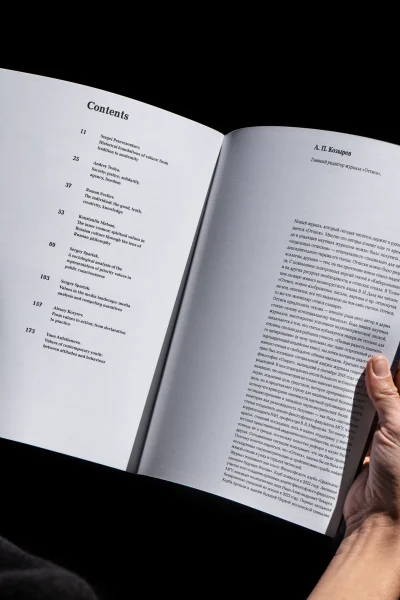
The new journal you are holding in your hands is called Ottisk. Many of its contributors will remember a time when the editorial offices of academic journals would give authors a bundle of offprints–extra copies of their articles printed especially for them. These could be passed on to colleagues, friends, or anyone else whose interest and attention the author genuinely hoped to attract. With the arrival of electronic publications on CyberLeninka and other online platforms, the need for such offprints no longer exists. In Vladimir Dahl’s Explanatory Dictionary of the Living Great Russian Language, we read: “Ottisk: any image, writing, picture, etc., impressed upon a surface; an imprint, anything produced on a surface by pressure. Ottisk may also mean a copy, as in an impression of a dictionary.”
An ottisk, or offprint, invited a response–indeed, that was precisely why an author would give one to a prospective reader. The trouble with academic journals today–a problem greatly magnified in the age of scientometrics–is that articles are increasingly published not to start a conversation, but to boost a researcher’s metrics. Having ‘discovered the joys of mutual citation’, as one witty video parodying Indian cinema once put it, we have almost lost the pleasure of actually reading one another–and of exchanging ideas freely. In September 2016, under my editorship, the contemporary philosophy journal Socrates devoted a special issue to a critique of scientometrics. It brought together the findings of a major study which argued that scientometrics not only inflicts serious damage on science by turning a means of assessment into an end in itself. It can also pose a threat to national security when the importance of a scientific publication is judged by whether it is indexed in Western scientometric databases. One of the articles, written by V. V. Mironov–then Dean of the Faculty of Philosophy at Moscow State University, a Corresponding Member of the Russian Academy of Sciences and a professor–was pointedly entitled “Scientometrics as a Form of Madness.” That issue of Socrates was to be the journal’s last. It found support among many principled members of the academic community, but it was decidedly out of step with the prevailing mood: the reform agenda in science was heading in a very different direction. Events since then, however, suggest that our concerns were justified. And so, I hope that Ottisk, whatever its future fate in the world of rankings and scientometric indicators, will achieve something more important: a genuine response in the minds and hearts of its readers.
The journal has emerged as the voice of the Philosophy Club Russia’s Civilisational Future, founded in 2022. One of those who played an active part in establishing the Club was Ivan Alexandrovich Chikharev, Associate Professor at the Faculty of Philosophy of Moscow State University and Candidate of Political Sciences, who died prematurely in 2023. The Club’s first meetings were held in the building of the former First Moscow Gymnasium on Volkhonka Street, an institution renowned for its alumni, many of whom left a profound mark on Russian culture. There was a certain symbolism of continuity in this. Yet the Club itself was born out of a new historical reality–one marked by tectonic shifts in the established world order, open conflict and military confrontation in different parts of the globe, as well as economic wars and blockades. These developments have brought to the fore a question that has been present in Russian thought since at least the early nineteenth century: that of civilisation. They have prompted us to consider Russia as a ‘country-civilisation’, to reflect on traditional values, and to begin systematic work aimed at strengthening civic identity and national cohesion. A ‘country-civilisation’ or ‘civilisation-state’ is not simply a reality that exists in its own right; to a far greater extent, it is something to be built and sustained. For Russia, the need to exist as an independent civilisation has become increasingly urgent if it is to withstand the challenges of the present day and cease gravitating towards other centres of power, whether in the West or the East.
The Club became one of the first attempts to reflect collectively on these questions. A collaborative monograph, Contours of Russia’s Civilisational Future, was subsequently published. The NEW ERA Centre for the Development of Humanitarian Technologies, which brings together mainly young researchers and graduates of Moscow universities, regularly carries out research projects and sociological studies. Together, these initiatives provide a solid foundation for bringing new voices into the discussion–from experienced academics and researchers in philosophy, political science, sociology and history to a younger generation of scholars already beginning to make their mark.
The pilot issue of the journal is devoted to values. Today, discussion of this subject is largely shaped by the language of ‘traditional values’, which has received formal expression in Presidential Decree No. 809. The decree identifies seventeen values presented as common to the different peoples and religious communities that make up Russia’s multinational state. For philosophy, of course, values are a familiar and important subject. They occupy a central place in Neo-Kantianism, where the language of value is arguably as significant as the language of virtue was in ancient philosophy. Figuratively speaking, one might even say that values are the virtues of the capitalist age. Perhaps what makes values particularly intriguing is the way they combine the objective and the subjective. The act of evaluation takes place within us and therefore inevitably involves subjective judgement and interpretation. Yet that which is valued exists objectively: it is part of being itself, just as we ourselves are part of it.
Values are a mirror in which we look at ourselves and try to see not who we are, but who we would like to become. Yet our understanding of the standard against which we measure ourselves can never be complete. In antiquity, this was described as natural law–something placed within us by an unseen hand. Values were also widely discussed in late Soviet philosophy, when ideas of humanising society and creating ‘socialism with a human face’ came to the fore. On the eve of the millennium of the Baptism of Rus’, the language of universal human values helped restore public recognition of the role played by the Russian Orthodox Church in the country’s history. At the time, universal values were contrasted with class-based ones and were associated with the Ten Commandments, although, naturally, some commandments received far more attention than others. ‘Thou shalt not kill’, for instance, was invoked much more often than ‘Thou shalt not make unto thee any graven image’ or ‘Remember the sabbath day.’
Time passed, historical eras changed, and the Soviet Union ceased to exist. It had been a country in which public morality formed part of the official ideology and was even codified in the Moral Code of the Builder of Communism. Yet what came to be presented as universal human values proved to be neither biblical nor Christian, but rather a particular expression of the values of modern Western capitalism. Russia’s Western partners, having proclaimed themselves the victors of the Cold War, assigned us a place somewhere beside the petrol pump. Having broken up the Soviet Union, they were already preparing to divide Russia itself, following the old maxim attributed to Philip of Macedon: ‘Divide and rule.’ On closer inspection, the rhetoric of universal human values turned out to be little more than a façade for a carefully calculated strategy, driven by the logic of an aggressor: corrupt first, then take possession. For this reason, the discourse of traditional values should not be seen as simply another attempt to restart a public conversation. It emerged as an urgent search for ways to restore the health of society–a form of social therapy intended to pull it back from the brink and to keep younger generations from drifting into groundless experimentation, where good and evil, the worthy and the unworthy, become inverted, confused and ultimately indistinguishable.
Higher education is one of the places where the values instilled by family and school are put to the test. It is therefore essential that universities should offer students not only academic training, but a school of life–a setting in which the values capable of giving their lives purpose and direction can inform their studies, their choice of profession and the beginning of their careers. Moscow State University has joined a consortium of federal state higher-education institutions whose work is aimed at implementing Presidential Decree No. 809 ‘On the Approval of the Fundamentals of State Policy for the Preservation and Strengthening of Traditional Russian Spiritual and Moral Values.’ The Consortium, which brings together leading Russian universities and higher-education institutions–Lomonosov Moscow State University, St Petersburg State University, the Russian State University for the Humanities, HSE University, RANEPA, Kosygin Russian State University, RUDN University named after Patrice Lumumba, Moscow Pedagogical State University, Herzen State Pedagogical University of Russia, the Institute of Ethnology and Anthropology of the Russian Academy of Sciences, and the Moscow Institute of Physics and Technology–conducts and will continue to conduct academic research and organise practice-oriented initiatives aimed at preserving and strengthening traditional values and ensuring their transmission from generation to generation.
Ottisk will be published quarterly and will address the most pressing issues and challenges facing our society, as well as the disciplines that study it. We invite scholars from universities and the wider academic community to contribute, particularly those who care about Russia’s civilisational future and who believe that our research and education should help strengthen the country’s sovereignty and support an independent path of civilisational development.